
Catalog status
Published closing window elapsed — verify on HiBid
At the recorded source check, HiBid listed Absolute Clock Collection Liquidation - Authentic & Original with 171 catalog lots in a timed online only auction. The published bidding window was August 14–25, 2026. The first lot was scheduled to close ; that first-lot time is not a promise that every lot is finished at that moment.
At the August 22 verification, the first catalog lot was scheduled just after 6:00 p.m. ET and the last catalog lot was scheduled for 6:32:30 p.m. ET, before any extensions. The live catalog showed a 10-second scheduled stagger between sequential lots at the August 22 verification. Published soft-close rule: The live lot interface stated that a bid placed during a lot’s final 90 seconds extends that lot by 90 seconds. These are historical event terms, not current bidding instructions.
Descriptive or promotional language in an event title or lot title is catalog wording. It is not, by itself, an independent finding about identity, age, maker, material, originality, condition, operation, rarity, or value. Review the preserved HiBid lot record for the published description, photographs, terms, and transaction evidence.
Published terms and buyer responsibilities
- All property was offered as-is, where-is, without expressed or implied warranties. Vintage and antique clocks were not guaranteed to work; the preserved photographs, description, condition language, and invoice remain the transaction evidence.
- The published event terms stated that bids were binding and could not be retracted.
- The published event terms stated that all sales were final.
- The published event terms stated 6.5% Florida sales tax on the hammer price plus buyer’s premium unless a valid resale or exemption certificate was on file. The final invoice and applicable law control.
- The published event terms identified major credit and debit cards and stated that the card on file could be charged. The applicable invoice and confirmed instructions control the completed transaction.
- The published terms offered shipping when requested and stated that it would be arranged and billed separately. The buyer was responsible for shipping, packing or handling, and insurance shown in the confirmed instructions or invoice.
- Published event materials offered online photo review and in-person preview by appointment before the sale.
- Published pickup terms required a confirmed appointment at 217 Capitol Court, Ocoee, Florida 34761.
- Questions: 689-500-9492 or help@biddingisopen.com.
Published bid increments
| Current bid range | Increment |
|---|---|
| $0–$95 | $5 |
| $95.01–$975 | $25 |
| $975.01–$9,750 | $250 |
| $9,750.01–$97,500 | $2,500 |
| Above $97,500 | $10,000 |
HiBid controls registration, bids, individual lot records, timers, extensions, status, invoices, results, and the transaction record. The published closing window elapsed; use HiBid to verify current status and review the transaction record.
A clock collection is a compact history of how people learned to organize work, travel, meals, broadcasts, school days, and private life around a shared minute. Cases show changing domestic taste. Dials reveal how designers balanced legibility with personality. Movements trace a path from skilled cabinet shops to mechanized production and, later, to electric power synchronized through the grid.
This catalog brings many of those stories into one place: familiar maker names, wall and mantel forms, novelty cases, electric clocks, advertising pieces, and designs that lean from traditional to emphatically modern. The discussion below focuses on American clockmaking because selected lots connect naturally to that history. It is not a claim that all 171 lots were made in the United States, nor is it a substitute for the catalog's identification of any individual object.
The event title includes the phrase “Authentic & Original.” That title should not be read as an independent statement that every part of every clock is original, unrestored, working, or made from a particular material. Those questions belong to the evidence and qualifications preserved on each lot page—and to the questions a bidder should resolve while reviewing any future catalog.
The best way to read a clock collection is twice: first as a group shaped by an era, then one object at a time through its marks, case, dial, movement, photographs, and record.
What the catalog titles contain
A searchable snapshot of 171 lot titles
Counting words in the August 22 catalog titles helps show the collection's breadth without turning those words into authentication or rarity findings. The groups overlap: one clock can be counted under a maker, a material word, a form, and catalog language at the same time. These are title counts, not mutually exclusive inventory classifications.
In particular, “RARE,” “NOS,” Bakelite, Catalin, Lucite, maker names, and model names reproduce or summarize catalog wording. A word count does not prove rarity, unused condition, material, maker, date, originality, or value for any individual object.
From workshop craft to an American clock industry
Early clocks were expensive combinations of specialized metalwork, woodworking, finishing, and hand adjustment. The major American change was not simply a new style; it was a new way of making timekeepers in repeatable parts and larger numbers. The Smithsonian's “Mechanizing Time” history describes Eli Terry's 1816 box clock as using mass-produced, interchangeable wooden movement parts. By 1830, the Smithsonian says, more than one hundred makers were producing wooden clock movements.
That concentration helped turn Connecticut into the center of an American industry. The National Association of Watch & Clock Collectors' overview of American clockmaking places Terry, Chauncey Jerome, Seth Thomas, and other makers within that Connecticut story. By 1850, the NAWCC says, fifteen Connecticut firms were producing more than half a million brass shelf clocks in a year.
Jerome advanced stamped brass movements and sold the familiar ogee clock in volume. According to the Smithsonian, the combination reduced cost, widened access, and supported exports. That history gives a collector a useful lens: an American clock can be both an expressive household object and evidence of manufacturing systems designed for scale.
Electric time entered the home
The next transformation linked the clock to electrical infrastructure. A traditional mechanical clock stores energy in a wound spring or falling weight and releases it through a regulating system. A synchronous electric clock can instead use the frequency of alternating current as its time reference. The clock was no longer only a self-contained mechanism; it participated in a network.
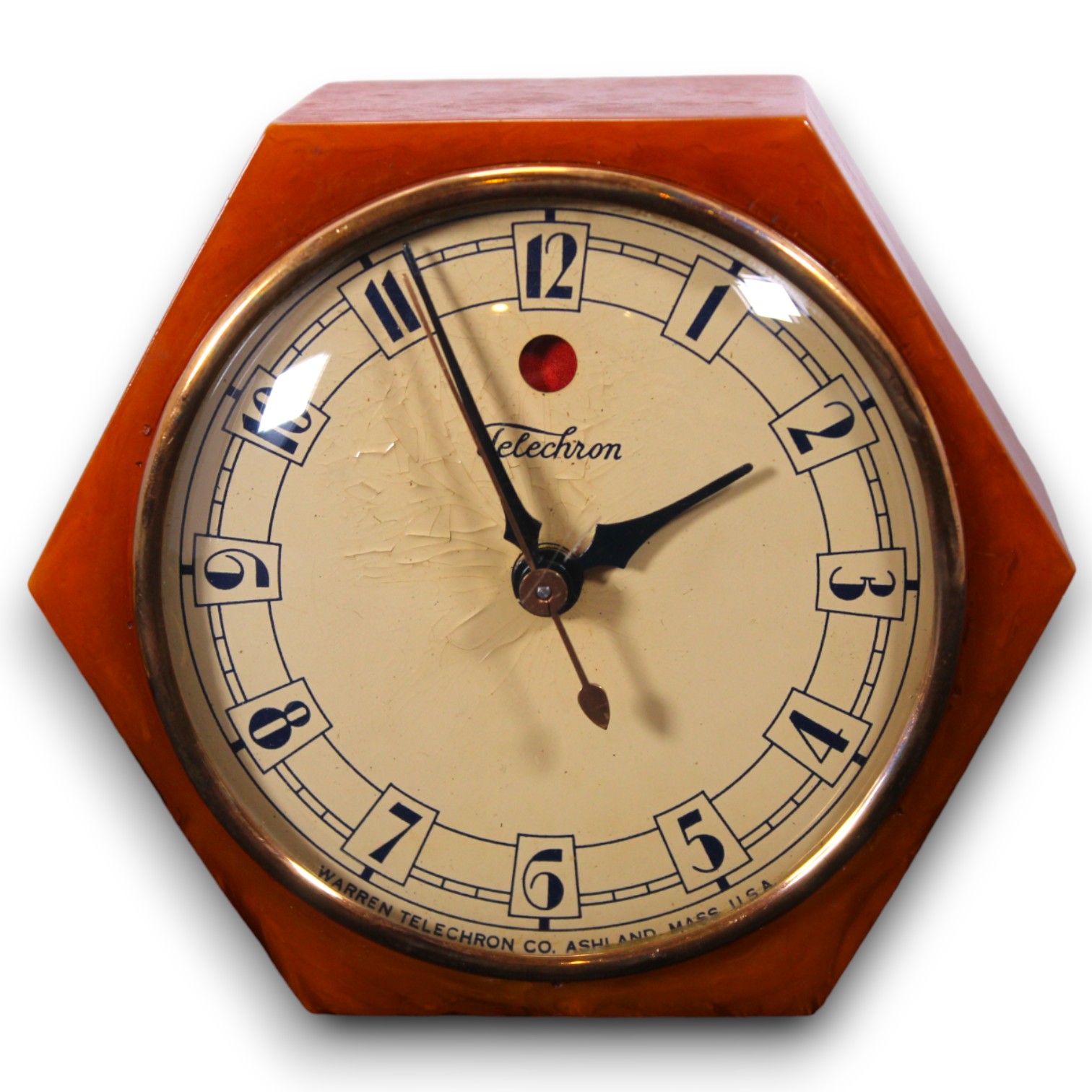
The Smithsonian's catalog record for a Warren Telechron electric clock follows Henry Warren's experiments from 1912, General Electric's interest by 1917, and Warren's self-starting synchronous motor in 1918. The company became Warren Telechron in 1926. GE-branded Telechron clocks followed after 1930, and the Smithsonian notes that electric clocks represented roughly 60% of clocks sold by 1933. General Electric took control of the company in 1943, and production continued through 1979.
Those dates explain why Telechron and General Electric names can appear across such varied cases. The underlying technology could be packaged as a plain kitchen wall clock, a restrained mantel form, a streamlined bedside clock, or a sculptural object meant to participate in a room's décor. The case was not incidental; it helped turn dependable electric time into a consumer object people wanted to see every day.
Makers, systems, advertising, and unusual displays
Maker history is most useful when it sends a bidder back to the evidence on a particular clock. The catalog includes title references to Revere, Hammond, Seth Thomas, Ansonia, Telechron, and General Electric, among others. The Library of Congress worker oral history connected to Seth Thomas, the Smithsonian's Hammond Postal Telegraph clock, and The Henry Ford's Warren Telechron / General Electric master-clock record provide institutional context. They do not authenticate the auction lots below.
A secondary or “slave” clock belongs to a system rather than keeping independent time in the ordinary household sense; Lot 705 is a catalog path for exploring that distinction. Projection and cyclometer displays solve the reading problem differently: Lot 704 projects a display, while Lot 721 uses the catalog's cyclometer wording. The lot pages, not these short descriptions, control exact identity, completeness, condition, and operation.
Clocks also sold attention. A Library of Congress photograph of a Dr Pepper advertising clock and the Smithsonian's GE and Telechron advertising records document the wider connection between time display and commercial messaging. Catalog examples include Lot 589, Lot 590, Lot 708, Lot 718. Their brand names and advertising descriptions are catalog-based, not new licensing, age, originality, or authenticity opinions.

Collecting the design as well as the mechanism
Collectors do not all approach clocks from the same direction. One person may follow a maker and model sequence. Another may study movements, electrical history, industrial design, domestic interiors, advertising, plastics, wood cases, or a specific period. A focused collection can be systematic; an eclectic collection can reveal unexpected connections between technology and taste.
Look across this catalog and the silhouette changes rapidly: circle, arch, square, novelty architecture, fruit form, and mirrored geometry. Numerals move from conventional Arabic figures to stretched Deco compositions. The same practical task—showing the time—becomes a field for color, proportion, typography, and new case-making techniques.
A broad event is especially useful for comparison. Put two dials side by side. Notice how one emphasizes minute reading while another emphasizes the shape of the whole object. Compare wall, shelf, and bedside proportions. Then return to the individual record, because a compelling design does not answer questions about marks, alterations, repairs, material, completeness, or operation.
Bakelite, Catalin, and Lucite: history is not authentication
Plastics changed what a clock case could look and feel like, from molded architectural shapes to translucent color and polished geometric surfaces. The Smithsonian's Bakelizer collection record and DuBois plastics archive provide industrial and documentary context for the development of plastics. That history does not identify the material of a clock from a web photograph.
The catalog titles use Bakelite 26 times, Catalin 14 times, and Lucite three times. Those words are useful search paths, but color, translucency, marbling, weight, sound, smell, and a seller's label should not be treated individually as conclusive authentication. Material identification may require maker documentation, construction evidence, careful inspection, and appropriate specialist testing. Never perform a destructive or hazardous test on a lot you do not own.
What rarity can—and cannot—mean
“Rare” appears in 47 catalog titles, but frequency of the word is not a rarity measurement. A defensible rarity conclusion asks a narrower question: rare compared with what exact maker, model, case, color, movement, production period, or surviving condition? It then looks for production records, period catalogs, serial or model evidence, documented examples, museum records, specialist literature, and comparable objects. Scarcity alone also does not guarantee collector demand or high value.
For this event, treat rarity language as a prompt for research. Compare the title with every image and mark, look for an exact model rather than a broadly similar shape, and ask what documentation supports the claimed variant. Absence from a quick web search is not proof that only a few examples exist.
Value drivers are not a clock appraisal
Value can be influenced by verified maker and model, case and movement completeness, originality, documented restoration, material, color, condition, operation, provenance, design appeal, current demand, and the number of informed bidders at a particular sale. Those factors can pull in different directions. A visually dramatic clock may have condition or completeness issues; a technically important clock may appeal to a narrower market.
Keep four numbers separate: an estimate is a pre-sale opinion or range; a current bid is only the latest position in an unfinished auction; the hammer price is the winning bid before premium, tax, shipping, and other applicable charges; and an appraisal is a purpose- and date-specific professional conclusion supported by its own method. IRS Publication 561 is tax-specific, but it illustrates the broader point that fair-market-value analysis has defined conditions and is not simply an asking price or one current bid. Nothing on this page is an appraisal of a clock or a prediction of its result.
Six catalog paths
Featured lots to open individually
These selections show the range of forms in the sale. Display titles are condensed from the HiBid catalog, with promotional qualifiers such as “RARE” omitted; material descriptors remain catalog-based and are not new authentication or condition opinions. Each card links directly to the named lot so bidders do not have to hunt through the catalog index.

Lot 570 · Condensed catalog-based title
Telechron Diameter 2H101 Mid-Century Wall Clock
HiBid catalogs this round wall-clock form as a Telechron Diameter 2H101. Its direct lot page is the place to review every photograph, the catalog notes, current bidding status, and fulfillment details.
Open Lot 570 on HiBid ↗
Lot 578 · Condensed catalog-based title
“Candlewick” 7H188 Mahogany Brass Clock
HiBid catalogs Lot 578 as the “Candlewick” 7H188 and uses mahogany and brass in the lot title. Compare the case, dial, back, markings, dimensions, and any catalog qualifications on the individual lot page.
Open Lot 578 on HiBid ↗
Lot 612 · Condensed catalog-based title
MasterCrafters #272 Fireplace Bakelite Clock
HiBid catalogs this sculptural novelty form as a MasterCrafters #272 fireplace clock and identifies Bakelite in the title. Use the linked record—not the short summary here—for condition, operation, material, and sale-status information.
Open Lot 612 on HiBid ↗
Lot 623 · Condensed catalog-based title
“Daphne” 3F53 Butterscotch Catalin Clock
HiBid catalogs Lot 623 as the “Daphne” 3F53 and identifies butterscotch Catalin in the title. The direct link preserves the seller’s complete wording, actual-item views, and current lot clock.
Open Lot 623 on HiBid ↗
Lot 625 · Condensed catalog-based title
“Lido” 4F75 Mirrored Glass Black Gold Clock
HiBid catalogs this design as the “Lido” 4F75 and describes mirrored glass, black, and gold in the title. Open Lot 625 to study the object from the catalog’s full set of views before deciding whether to bid.
Open Lot 625 on HiBid ↗
Lot 639 · Condensed catalog-based title
Seth Thomas Catalin Apple Clock E898-000
HiBid catalogs Lot 639 as a Seth Thomas E898-000 apple clock and identifies Catalin in the title. Confirm marks, dimensions, visible details, condition language, and current availability on HiBid.
Open Lot 639 on HiBid ↗How to read a clock before you collect it
A useful research record starts with what can be documented. The NAWCC's research-request guidance asks for clear photographs of the case, dial, movement, and trademarks or labels, along with dimensions and provenance when known. The organization also makes clear that its research service does not provide value opinions. That separation is healthy: identification, condition, originality, operation, and market value are related questions, but they are not the same question.
When reviewing an online lot, work in a repeatable order:
- Read the complete lot title and description. Note exactly what the catalog states and what it does not state.
- Inspect every photograph. Look at the case, dial, hands, cord, back, underside, fasteners, labels, movement views if supplied, and any visible wear or damage.
- Compare marks with the form. A dial name, label, movement mark, and case style may each contribute different evidence. Do not ask one mark to prove everything about the object.
- Check dimensions and scale. A close photograph can make a bedside clock and a wall clock feel surprisingly similar.
- Separate catalog language from your conclusion. Terms such as Bakelite, Catalin, mahogany, original, rare, restored, or working should be traced to the exact lot record and supporting evidence.
- Resolve missing evidence first. In any future auction, contact the auction company while there is still time if a needed view, measurement, or qualification is missing.
Plan for ownership before placing a bid
Collection decisions do not stop at the bid. The published event terms listed the buyer's premium, payment timing, shipping or pickup path, and packing or handling responsibilities. HiBid marked shipping available when the catalog was checked on August 22, 2026, but the practical method could depend on the lot and destination. The applicable invoice and confirmed instructions control each completed transaction.
Older electric clocks deserve deliberate handling. Do not use a sale photograph as evidence that wiring is safe or that a clock operates continuously and accurately. Preserve labels and loose parts, avoid improvised cleaning, and seek an appropriate clock or electrical professional when the object's mechanism, cord, material, or finish calls for expertise. A careful first inspection protects both the object and the person living with it.
Why this event matters
A single clock can be charming. A collection shows a system: manufacturers competing for the home, designers translating technology into personality, households adapting to shared schedules, and collectors preserving examples that mass production once made ordinary. The 171-lot catalog lets bidders follow those threads across decades and forms without pretending that every object tells the same story.
Start with the designs that catch your eye, then slow down. Open the individual lot. Read the current record. Compare it with neighboring clocks. Decide what evidence you need and what the object is worth to you under the published terms. That combination of curiosity and discipline is what turns browsing into collecting.
History sources and further research
- Smithsonian National Museum of American History: Mechanizing Time — Early American mass production, Eli Terry, Chauncey Jerome, brass movements, affordability, and export.
- National Association of Watch & Clock Collectors: American Clockmaking — Connecticut clockmaking and maker context.
- Smithsonian: Warren Telechron electric clock — Henry Warren, synchronous electric time, General Electric, and Telechron chronology.
- NAWCC research requests — The photographs and object information that support responsible clock research.
- Library of Congress: Seth Thomas clock-factory worker oral history — A primary-source worker account connected to the Seth Thomas clockmaking community.
- Smithsonian: Hammond Postal Telegraph clock — An institutional collection record connecting Hammond clockwork with commercial time display.
- The Henry Ford: Warren Telechron / General Electric master clock — An institutional object record for a master-clock system in the Telechron and GE story.
- Library of Congress: Dr Pepper advertising clock photograph — A documented example of a clock serving as advertising as well as a timekeeper.
- Smithsonian Archives: General Electric and Telechron advertising records — Archival advertising records that help place branded electric clocks in commercial context.
- IRS Publication 561: Determining the Value of Donated Property — Tax-specific guidance used only to illustrate that fair market value is distinct from a seller’s label, asking price, or one current bid—not as an appraisal of any lot.
- Smithsonian: Bakelizer — An industrial-history object connected to phenolic-plastics manufacturing; not authentication evidence for any catalog lot.
- Smithsonian Archives: John Wesley Hyatt and Leo H. Baekeland / DuBois plastics collection — Archival plastics-history context; not proof that a particular clock case is Bakelite, Catalin, Lucite, or original.