
Catalog status
Verified closed
At the recorded source check, HiBid listed Father's Day Retro Advertising: Real Porcelain & Neon Signs with 150 public catalog lots in a timed online only auction. The published bidding window was June 11–21, 2026. No defensible exact first-lot closing time is published on this permanent record. The verified date window is shown without inventing a time.
Published soft-close rule: The historical event used a timed soft close; this archive does not reconstruct an unverified extension interval. These are historical event terms, not current bidding instructions.
Descriptive or promotional language in an event title or lot title is catalog wording. It is not, by itself, an independent finding about identity, age, maker, material, originality, condition, operation, rarity, or value. Review the preserved HiBid lot record for the published description, photographs, terms, and transaction evidence.
Published terms and buyer responsibilities
- The historical catalog described modern vintage-style reproduction displays and disclaimed trademark affiliation. This archive makes no period-original, age, licensing, or endorsement claim.
- The retained final report contains 150 records: 146 recorded sold and four recorded buy back.
- Nationwide shipping was offered under the historical event terms.
- Pickup was offered under the completed event terms.
Historical evidence note: terms not shown here were not recovered or independently verified for this archive and have not been invented. Use the archived HiBid record and retained event documents for the surviving transaction evidence.
HiBid controls registration, bids, individual lot records, timers, extensions, status, invoices, results, and the transaction record. Use the linked archived records for the preserved sale evidence.
When many modern vintage-style neon and porcelain displays appear together, the catalog becomes useful for comparing fabrication families, sizes, graphics, and condition, but neither the assortment nor a familiar brand subject establishes period originality, authorization, production scarcity, or historical roadside use.
Reproduction sign-series research guide
A broad reproduction catalog is a comparative design sample—not a census of historical signs
Repetition can be valuable evidence. Similar cabinets, backs, tube supports, power components, enamel finishes, mounting systems, and dimensions can reveal a contemporary product family more clearly when many examples are viewed side by side.
Repetition can also mislead. Seeing many historical logos in one event does not prove they came from many old stations, and seeing only one example of a graphic does not make that variant rare. The research task is to distinguish catalog assortment from production history and production history from the history of the image being reproduced.
Use the catalog to compare consistent construction and meaningful exceptions
Build a feature matrix across actual-item photographs: dimensions, silhouette, sidedness, cabinet depth, back design, access panel, enamel face, tube layout, support style, power component labels, switch, cord, mounting points, and packaging. Shared features can identify a series; exceptions can flag repairs, substitutions, different suppliers, or a genuinely distinct configuration.
The matrix should remain descriptive. It cannot establish who fabricated the pieces, whether every material term is correct, or how many were produced unless labels, invoices, serials, or maker records supply that link.
Advertising archives explain the graphic; object evidence explains the display
Library of Congress prints and labels and Smithsonian roadside-sign objects document the changing commercial imagery of products, fuel, automobiles, travel, and service. They help identify whether a shield, word mark, mascot, or color system existed in a historical period.
A copied design remains a later object. Keep four questions separate: What does the graphic reference? What materials are present? When and by whom was this display fabricated? What object-specific history follows it? Only the last two can establish the age and provenance of the auction piece.
What can influence value within a modern reproduction series
A series creates strong internal comparisons when every example remains in the correct modern evidence class.
- Relative fabrication
- Compare tube symmetry, bends, supports, enamel registration, metalwork, access, finish, cabinet depth, frame, and mounting design across the series.
- Size and configuration
- Diameter or height, sidedness, die-cut versus cabinet form, number of tube colors, animation, frame, and transformer or power-supply arrangement affect cost and display.
- Condition exceptions
- Broken glass, chips, dents, corrosion, rewiring, replacement components, incomplete mounts, and inconsistent repairs can separate one lot from a visually similar peer.
- Graphic demand
- Subject, typography, color, silhouette, collector fit, and available display space can affect demand without changing the object's modern age.
- Provenance of fabrication
- Maker labels, receipts, serials, custom orders, production dates, and service invoices can add useful history to a contemporary piece.
Internal catalog comparison can show relative execution and demand in one event. It does not create a present appraisal or a comparison with period-original advertising artifacts.
How to distinguish a one-catalog variant from a limited production run
One appearance in an auction may reflect consignment selection, not factory scarcity.
- Cluster the construction family: Group pieces by cabinet, back, support, enamel, power, mounting, and dimension patterns before counting graphic variants.
- Resolve exact variants: Record subject, size, shape, colors, tube plan, sidedness, frame, component labels, and any serial or edition mark.
- Seek maker records: Use invoices, catalogs, order sheets, fabricator confirmations, serial sequences, and dated photographs to establish production.
- Search beyond one event: Review other auctions, retailer and maker archives, collection records, and dated owner documentation for matching modern examples.
- Keep historical supply separate: Do not add period originals and modern reproductions into one scarcity count simply because they display the same brand art.
If the evidence stops at 'only example of this graphic in the catalog,' publish exactly that limited observation and no broader rarity claim.
Disclosure, affiliation, repair-state, and electrical boundaries
Consistent modern-production language protects both the buyer and the historical record; it should remain visible wherever the pieces are discussed.
- Modern reproduction
- State later manufacture or vintage-style reproduction directly and do not use ambiguous 'vintage sign' shorthand that can imply age.
- Material versus origin
- Real formed glass and kiln-fired enamel can support material descriptions while leaving maker, country, date, and authorization unresolved.
- No affiliation
- The owner of a depicted mark is not represented as fabricator, licensor, seller, approver, or endorser without specific evidence.
- Service history
- Replacement glass, rewiring, power-supply changes, repaint, cabinet repair, and altered mounting should be recorded even for a recently made display.
- Electrical safety
- Illumination is not a safety or installation test; corrosion, moisture, wiring, grounding, components, enclosure, and the intended location require qualified review.
Standard-looking pieces still need object-specific packing
A repeated cabinet size can support a packing design, but glass routing, repairs, weight, frames, and protrusions must be confirmed for every object.
- Inspect each assembly
- Record glass clearance, loose supports, electrode ends, cabinet distortion, access panels, component mounts, and frame stability.
- Use repeatable documentation
- Assign object IDs to photographs, cords, hardware, removed components, crate diagrams, and condition exceptions so similar pieces are not mixed.
- Keep loads off glass
- Support the cabinet or structural frame independently and prevent cushioning, straps, hardware, or crate faces from contacting tubes.
- Design for handling
- Use rigid blocking, bracing, edge and face protection, orientation, shock clearance, and pallet or crate structure suited to repeated movement.
- Verify destination installation
- Dimensions, weight, doorway and wall path, electrical supply, structure, landlord rules, permits, and professional installation remain buyer-side planning questions.
Authoritative research sources
These institutional and government sources explain the research method and safety boundaries. They do not authenticate, appraise, test, or certify any auction lot.
- National Park Service Preservation Brief 25: The Preservation of Historic Signs — Historic sign materials, development, documentation, change over time, preservation principles, and specialist-repair boundaries.
- Library of Congress: U.S. Patent Office Advertising Prints and Labels Collection — Primary-source American commercial prints and labels from roughly 1874–1940 for researching period graphics and advertising context.
- Smithsonian National Museum of American History: Phillips 66 Gasoline Sign — A documented porcelain-enamel-on-steel roadside advertising object with maker-era and design context.
- Smithsonian National Museum of American History: Hamons Court Neon Sign — A documented steel, glass, and neon Route 66 object with maker, place, use, and ownership history.
- The Neon Museum: Preservation in Action — Condition assessment, historical research, original-material preservation, and specialist metal, glass, wiring, structural, transport, and testing work.
- UL Solutions: The Signs Are Everywhere — UL 48 and electric-sign safety context, including corrosion, moisture, wiring, construction, and installation concerns.
- U.S. Environmental Protection Agency: Light Systems and Demolition — Some neon systems may contain mercury and should remain intact for appropriate handling and recycling rather than being crushed.
Recorded auction outcomes
Selected results from this completed event
These are dated hammer results from this auction's retained transaction record. A hammer result is the accepted bid before the buyer's premium, tax, shipping, handling, and other applicable charges; it is not the buyer's total cost, a present asking price, an appraisal, or a prediction of another object's result. Titles may be condensed from retained catalog or result-report wording.

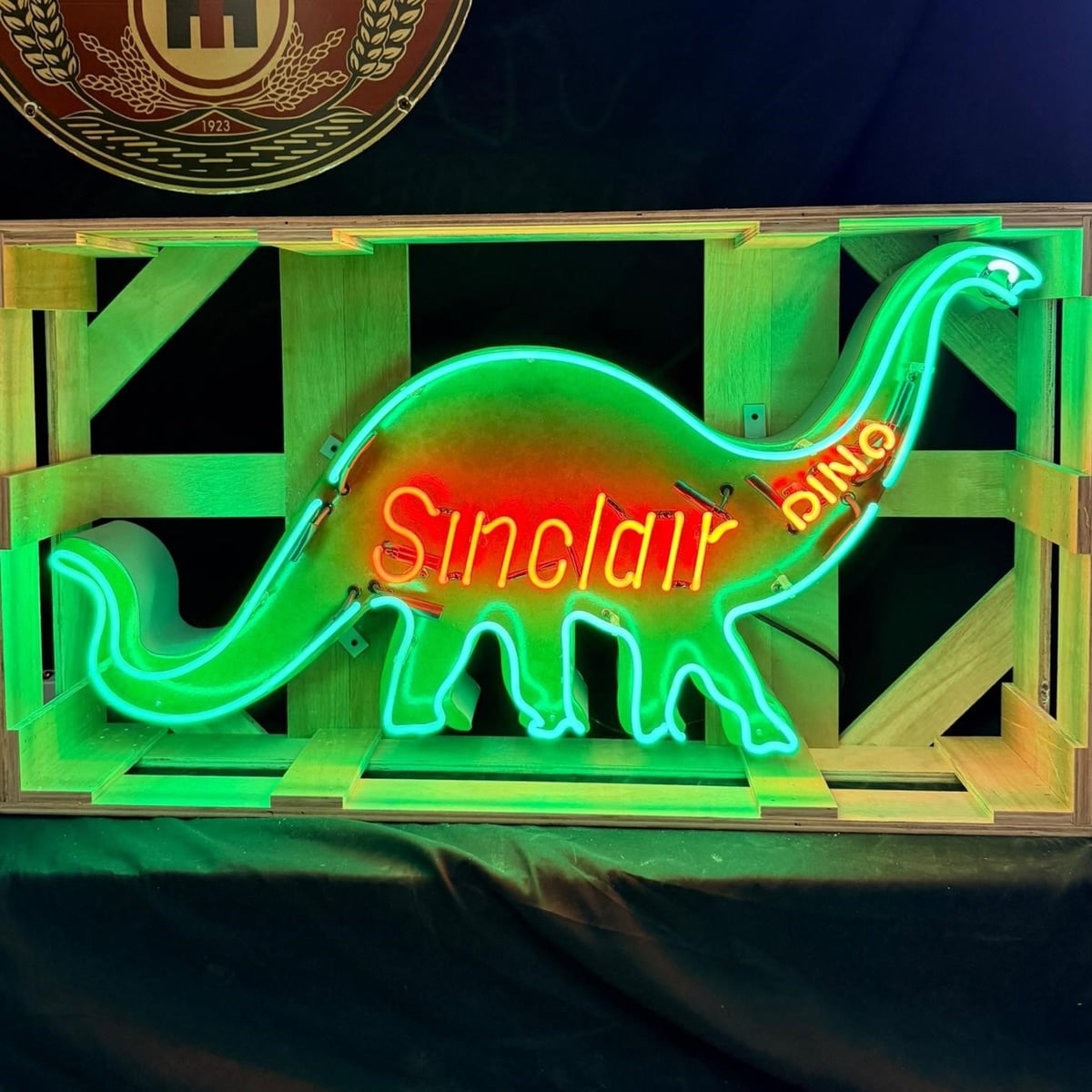
Lot 22 · Archived catalog photograph
42" Vintage Sinclair Dino Real Neon Sign
The retained result report records a $3,100 hammer price for Lot 22. Open the direct HiBid lot record for its historical catalog wording and photographs.

Lot 19 · Archived catalog photograph
48" A&W Root Beer Neon Porcelain Sign
The retained result report records a $1,600 hammer price for Lot 19. Open the direct HiBid lot record for its historical catalog wording and photographs.

Lot 15 · Archived catalog photograph
48" Mobilgas Round Neon Porcelain Sign
The retained result report records a $1,550 hammer price for Lot 15. Open the direct HiBid lot record for its historical catalog wording and photographs.

Lot 18 · Archived catalog photograph
48" VW Volkswagen Neon Porcelain Sign
The retained result report records a $1,450 hammer price for Lot 18. Open the direct HiBid lot record for its historical catalog wording and photographs.

Lot 12 · Archived catalog photograph
36" Super Chevrolet Service Neon Porcelain Sign
The retained result report records a $1,300 hammer price for Lot 12. Open the direct HiBid lot record for its historical catalog wording and photographs.
These are archived actual-item photographs from this completed Bidding Is Open event. The linked HiBid lot records preserve the historical seller wording, additional photographs, and transaction context. A photograph alone does not establish age, originality, material, condition, operation, rarity, affiliation, or current value.
| Lot | Condensed historical lot wording | Reported hammer |
|---|---|---|
| 22 | 42" Vintage Sinclair Dino Real Neon Sign | $3,100 |
| 19 | 48" A&W Root Beer Neon Porcelain Sign | $1,600 |
| 15 | 48" Mobilgas Round Neon Porcelain Sign | $1,550 |
| 18 | 48" VW Volkswagen Neon Porcelain Sign | $1,450 |
| 12 | 36" Super Chevrolet Service Neon Porcelain Sign | $1,300 |
Listing-title adjectives remain historical catalog wording unless independently supported. These selected outcomes do not establish authenticity, originality, condition, operation, rarity, or current market value.