
Catalog status
Verified closed
At the recorded source check, HiBid listed Timeless Treasures #2: Vintage & Antique Clock Collection with 350 unique final-report lot records in a live webcast only auction. The published bidding window was September 5–27, 2024. No defensible exact first-lot closing time is published on this permanent record. The verified date window is shown without inventing a time.
Descriptive or promotional language in an event title or lot title is catalog wording. It is not, by itself, an independent finding about identity, age, maker, material, originality, condition, operation, rarity, or value. Review the preserved HiBid lot record for the published description, photographs, terms, and transaction evidence.
Published terms and buyer responsibilities
- Property was offered as-is and was generally described as untested. This archive does not guarantee identity, age, originality, completeness, material, condition, or operation.
- The retained final webcast report contains 350 unique records: 349 recorded as sold and one recorded as passed.
- Applicable sales tax was required under the historical event terms.
- The event offered shipping within the continental United States on most lots at the buyer’s cost and stated a $15 package service charge.
- The historical terms offered pickup Friday through Sunday, 9:00 a.m.–2:00 p.m., following the sale. This archive does not invent exact pickup dates from that relative wording.
Historical evidence note: terms not shown here were not recovered or independently verified for this archive and have not been invented. Use the archived HiBid record and retained event documents for the surviving transaction evidence.
HiBid controls registration, bids, individual lot records, timers, extensions, status, invoices, results, and the transaction record. Use the linked archived records for the preserved sale evidence.
This permanent collection guide preserves a verified snapshot of a completed clock auction and uses the catalog as a doorway into American manufacturing, electric timekeeping, case design, and responsible collecting. It is an archive—not a current offer, a clock authentication, an appraisal, or a promise that any item operates.
Verified event snapshot
What the final event record shows
Bidding ran September 5–27, 2024. The retained final webcast report contains 350 unique lot records: 349 recorded sold · 1 recorded passed. That reconciled report count is more precise than promotional quantity language used before the sale. The auction used a 15%, and the event offered shipping within the continental United States at the buyer's cost.
The property was offered as-is and was generally described as untested. A historical result does not establish present operation, completeness, originality, material, age, or condition. The individual HiBid records preserve the sale photographs and wording; the retained report preserves the recorded disposition.
How American clockmaking became an industry
A clock begins as precision work, but the American clock industry also became a story about repeatable parts, mechanized production, distribution, and price. The Smithsonian's Mechanizing Time history describes Eli Terry's use of mass-produced, interchangeable wooden movement parts and the rapid expansion of Connecticut clockmaking. It also follows Chauncey Jerome's stamped-brass movements, which made clocks cheaper to manufacture, easier to ship, and practical for a much wider market.
The National Association of Watch & Clock Collectors' American clockmaking overview places Terry, Jerome, Seth Thomas, and other makers within that Connecticut manufacturing network. The important collecting lesson is that a clock can be both a designed household object and evidence of a production system. Case, dial, movement, label, and hardware may each tell a different part of that story.
Telechron and time synchronized through the electric grid
Mechanical clocks regulate stored energy from a spring or weight. A synchronous electric clock instead uses the frequency of alternating current as its timing reference. That linked the household clock to a larger electrical network and allowed manufacturers to put a common timekeeping technology inside a remarkable range of wall, shelf, bedside, advertising, and novelty cases.
The Smithsonian's record for a Warren Telechron electric clock traces Henry Warren's work on synchronous electric time, the development of a self-starting motor, the Telechron name, and the company's relationship with General Electric. That institutional chronology helps explain why Telechron-related models appear in many styles and price points. It does not authenticate a maker, date, movement, or case for any auction lot.
For a collector, model numbers and movement markings matter because outwardly similar clocks can have different mechanisms, finishes, or production variants. Compare the dial signature with the back label, movement, fasteners, cord entry, dimensions, and documented model references. A case shape alone is rarely enough for a complete identification.
Ansonia, decorative cases, and the room around the clock
The catalog's Ansonia-titled lots broaden the view beyond synchronous electric time. Decorative kitchen, shelf, and mantel clocks could combine metal movements with wood, glass, painted surfaces, applied ornament, or architectural case forms. An etched-glass door, a shaped crest, a visible pendulum, or a strongly patterned dial let the clock participate in the room as furniture and decoration.
Design comparison is useful, but it should remain separate from attribution. A familiar silhouette does not prove maker, model, age, or originality. Look for consistent marks, construction, dimensions, hardware, dial printing, movement evidence, and documented comparisons. Replacement hands, refinished cases, married movements, later cords, and repaired glass can all affect how a clock should be described without necessarily erasing its interest.
Cases record changes in material and taste
A clock case protects the mechanism, but it also sells the object. Wood-toned traditional forms, mirrored faces, pressed metal, clear plastics, colored phenolic plastics, and streamlined geometric shells speak to different rooms and audiences. Typography can be equally revealing: compare highly legible commercial dials with compact bedside numerals or dramatic Art Deco arrangements.
Material words need evidence. A catalog label such as Bakelite, Catalin, Lucite, mahogany, or brass should be checked against marks, construction, manufacturing references, and appropriate specialist examination. Color, translucency, weight, sound, or one web photograph is not conclusive. Avoid destructive tests, solvents, heat, aggressive polishing, or improvised chemical methods—especially on an object you do not yet own.
Recorded auction outcomes
Six featured lots from the completed event
These links preserve examples across electric, decorative, and commercial clock forms. Titles below are condensed from the historical catalog; promotional rarity qualifiers are omitted. The reported hammer is the winning bid before the buyer's premium and other charges, not the buyer's total cost.

Lot 555 · Archived catalog photograph
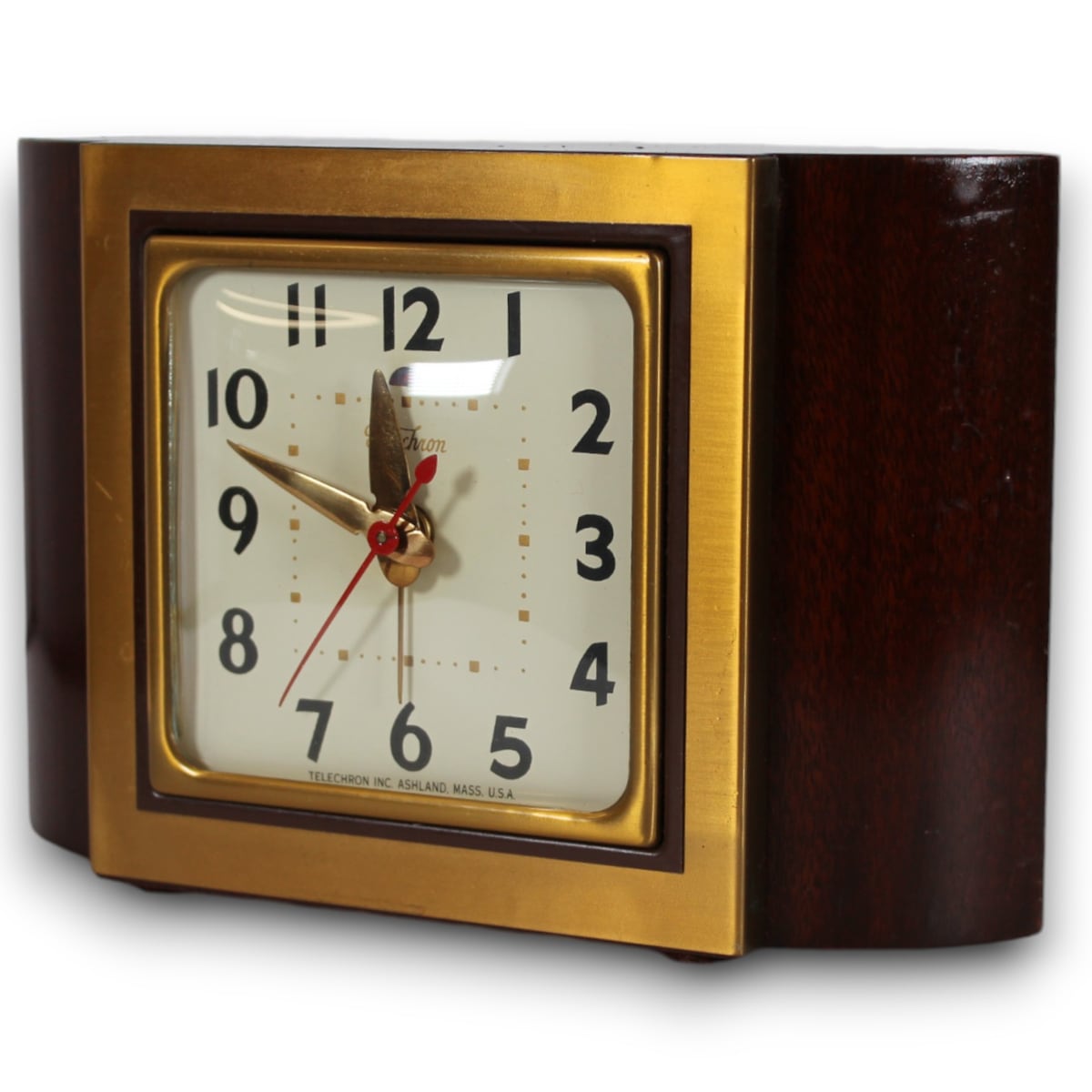
“Coronado” 7H165 Satin Mahogany Telechron Clock
The historical HiBid title supplied the Coronado model wording and satin-mahogany description. The archived lot record preserves the full photography, catalog language, and recorded transaction context.

Lot 546 · Archived catalog photograph
“Debutante” 4F52 Easel Telechron Clock
This condensed title omits the old promotional rarity qualifier. Use the linked HiBid lot for the historical seller wording, images, and result record.

Lot 449 · Archived catalog photograph
“Somerset” CH387 Telechron Clock
The model name and number are retained as historical catalog wording. They are not a new authentication, condition, or rarity conclusion.

Lot 453 · Archived catalog photograph
Ansonia “Kensico” Etched-Glass Kitchen Clock
The maker and Kensico wording come from the historical lot record. The photographs and old description should be reviewed together before drawing conclusions about age, completeness, or originality.
These are archived actual-item photographs from this completed Bidding Is Open event. The linked HiBid lot records preserve the historical seller wording, additional photographs, and transaction context. A photograph alone does not establish age, originality, material, condition, operation, rarity, affiliation, or current value.
| Lot | Condensed catalog title | Reported hammer |
|---|---|---|
| 555 | “Coronado” 7H165 Satin Mahogany Telechron Clock | $65.00 |
| 546 | “Debutante” 4F52 Easel Telechron Clock | $95.00 |
| 449 | “Somerset” CH387 Telechron Clock | $170.00 |
| 453 | Ansonia “Kensico” Etched-Glass Kitchen Clock | $22.50 |
| 180 | Ansonia One-Day Loud-Ticker Clock | $50.00 |
| 133 | 15-Inch “Commercial Clock” 1H915 Telechron Clock | $27.50 |
These are dated, event-specific hammer results. They exclude the 15% buyer's premium, sales tax, shipping, handling, insurance, and any other applicable charges. They are not current asking prices, appraisals, investment guidance, or predictions of what the same or a similar clock would bring in another sale.
A disciplined way to research a collectible clock
The NAWCC's research-request guidance asks for photographs of the case, dial, movement, trademarks or labels, dimensions, and provenance when known. That is a sound model for personal research because it begins with observed evidence rather than a desired conclusion.
- Record the object as found. Photograph every side, the dial, rear, underside, labels, cord, hardware, and movement only when it can be accessed safely.
- Transcribe marks exactly. Keep a model number, patent wording, retailer name, movement mark, and case label separate until evidence shows how they relate.
- Measure before comparing. Proportion and scale help distinguish models that look nearly identical in isolated photographs.
- Build a dated comparison set. Prefer exact model and case matches with photographs and documented outcomes over broad “similar clock” listings.
- Separate identification from condition. A correctly identified clock may still be incomplete, altered, unsafe, or non-operating.
- Write uncertainty down. “Cataloged as,” “mark reads,” “not opened,” and “operation not verified” are useful evidence states, not weaknesses.
Rarity requires a defined comparison
A defensible rarity statement identifies the exact maker, model, movement, case, color, size, production period, and condition being compared. It then looks for period catalogs, factory or distributor records, serial and model sequences, documented institutional examples, specialist literature, and a sufficiently broad history of public appearances. A title word, low search-result count, unusual color, or one seller's description cannot establish rarity on its own.
Scarcity and value are also different. A genuinely uncommon variant may attract few collectors; a common model in exceptional condition may face wider demand. For this archive, rarity language remains attributed to the old catalog unless supporting evidence is linked to a specific conclusion.
What can influence clock value
Relevant factors can include verified maker and model, case and movement completeness, original versus replaced parts, documented restoration, material and color, dial and finish condition, provenance, design appeal, operation, current collector demand, sale venue, and the number of informed bidders present at a particular moment. None of those factors operates alone.
Keep estimate, current bid, hammer result, buyer's total, asking price, and appraisal distinct. An appraisal is purpose-, market-, and date-specific. A hammer result is one historical transaction under one event's terms. This page reports the latter and does not provide the former.
Preservation and electrical safety come before display
Treat an older electric clock's operation and wiring as unverified unless a qualified inspection says otherwise. A brief sale demonstration cannot establish continuous safe operation. Do not energize a clock with a cracked plug, brittle insulation, exposed conductor, loose socket, damaged housing, evidence of overheating, or an unknown internal modification. Have an appropriate clock or electrical professional evaluate it before regular use.
Preserve labels, loose parts, old cords, and documentation even when a safer replacement is needed; they may contain historical evidence. Before cleaning, identify the surface. Water, household cleaners, metal polish, wax, or solvents can lift dial printing, stain wood, craze plastics, remove patina, or damage finishes. Photograph the object first, support it during transport, and avoid forcing a stuck winding, setting, or chime mechanism.
Institutional history and research sources
- Smithsonian National Museum of American History: Mechanizing Time — American clock industrialization, interchangeable manufacture, brass movements, affordability, and export.
- Smithsonian: Warren Telechron electric alarm clock — Institutional Telechron, synchronous-time, Henry Warren, and General Electric context.
- NAWCC: American Clockmaking — Maker and manufacturing context for American clock research.
- NAWCC research requests — Evidence fields useful for responsible clock-identification research.