
Catalog status
Verified closed
At the recorded source check, HiBid listed Absolute American Advertising Auction: Real Neon & Porcelain with 111 public catalog lot pages in a live webcast only auction. The published bidding window was May 7–18, 2026. No defensible exact first-lot closing time is published on this permanent record. The verified date window is shown without inventing a time.
Descriptive or promotional language in an event title or lot title is catalog wording. It is not, by itself, an independent finding about identity, age, maker, material, originality, condition, operation, rarity, or value. Review the preserved HiBid lot record for the published description, photographs, terms, and transaction evidence.
Published terms and buyer responsibilities
- The controlling event terms offered property as-is and without warranty. This archive makes no new promise that an electrical display operated at sale or remains safe to energize.
- The completed event was advertised as absolute and without reserve. The unresolved public-catalog versus ring-report count prevents an aggregate sell-through claim on this page.
- Applicable sales tax was required under the historical event terms.
- Nationwide shipping was offered at the buyer’s cost; packing, insurance, and delivery were separate buyer responsibilities under the event terms.
- Pickup was offered by appointment at the event-time Ocoee location, and buyers were responsible for loading.
Historical evidence note: terms not shown here were not recovered or independently verified for this archive and have not been invented. Use the archived HiBid record and retained event documents for the surviving transaction evidence.
HiBid controls registration, bids, individual lot records, timers, extensions, status, invoices, results, and the transaction record. Use the linked archived records for the preserved sale evidence.
This permanent archive guide examines a completed auction of newly made, vintage-style illuminated display pieces. The historical catalog described the pieces as using real formed-glass neon and kiln-fired porcelain-enamel construction, but they were not represented here as period-original roadside advertising signs. Cataloged material construction and historical age are separate questions.
Verified event snapshot
One event, two record counts
Bidding ran May 7–18, 2026 in an absolute live webcast auction with no reserve. The public HiBid catalog exposed 111 lot pages. The retained ring report contains 116 retained ring-report records. Aggregate disposition withheld pending reconciliation Because those systems can count or retain records differently, this archive preserves the discrepancy instead of replacing one number with the other.
The property was sold as-is and without a warranty. Descriptive wording about testing or illumination did not create a continuing guarantee of function. A historical photograph or result does not establish present condition, electrical safety, completeness, or operation.
Real materials do not make a sign period-original
A newly fabricated sign can use glass tubing, electrodes, luminous gas, sheet metal, and kiln-fired porcelain enamel while borrowing the typography, shape, and imagery of earlier advertising. Those are meaningful construction details. They do not prove that the object was made during the era its design evokes, installed at a historic business, authorized by the depicted brand, or preserved from an original commercial location.
Four evidence questions should remain separate: what is it made from, when was it made, who made it, and what documented history follows that exact object. The 2026 event answered the first at a catalog level by describing real formed-glass neon and kiln-fired porcelain-enamel pieces. It did not turn the collection into period advertising artifacts.
Why neon and porcelain became roadside landmarks
Commercial signs help explain how businesses competed for attention from pedestrians and motorists. The National Park Service's Preservation Brief 25, The Preservation of Historic Signs, treats signs as part of a building and street's historic character. It follows the rise of standardized commercial imagery, electric illumination, exposed bulbs, porcelain enamel, and neon while emphasizing that sign preservation begins with understanding the specific sign rather than stripping it of its setting and evidence.
Along highway corridors, scale, color, silhouette, and repeated brand marks had to communicate at speed. The National Park Service's Route 66 sign-preservation guidance shows why surviving roadside signs are read as architecture, advertising, craft, and community history at once. The Library of Congress' Emergence of Advertising in America collection supplies a broader primary-source path into how brand imagery and commercial persuasion changed over time.
That history explains the appeal of vintage-style display pieces without rewriting their age. A reproduction can reference the visual language of a filling station, dealership, restaurant, or product campaign. It should still be described as a later object when that is what the evidence supports.
How a formed-glass neon display works
Traditional luminous tubing is heated and bent to a pattern, fitted with electrodes, processed, filled, and connected to a suitable high-voltage power source. “Neon” is often used as a general category name, even though different gases, glass colors, coatings, and combinations can produce different hues. The tubing, electrode connections, supports, wiring, transformer or power supply, enclosure, and mounting structure all contribute to a complete installation.
Real formed glass is a material and fabrication description—not proof of age or safe operation. A catalog photograph cannot show every hairline crack, stressed support, wiring issue, transformer fault, or prior repair. The NPS account of Route 66 neon restoration in Missouri illustrates how historic-sign work can require documentation, skilled tube fabrication, metal repair, electrical work, and coordinated installation rather than a cosmetic touch-up.
Porcelain enamel is glass fused to metal
Porcelain-enamel signs use a vitreous coating fired onto a metal substrate. The fused surface can produce saturated color, a glossy finish, and strong weather resistance. Multiple colors or layers may require separate preparation and firing steps. Edges, mounting holes, bends, impacts, and corrosion at exposed metal remain important condition areas even when the broad face looks bright.
“Porcelain” describes the coating system; it does not date the object. Fresh enamel can be applied to newly formed metal using a historic-looking shape and graphic. Conversely, surface wear alone does not prove age because distress can be introduced deliberately. Examine the back, edge profile, fasteners, mounting pattern, substrate, graphics, fabrication method, and documented provenance together.
Recorded auction outcomes
Seven featured lots from the completed event
The display titles below are condensed from historical catalog wording and name the advertising subjects depicted. They do not imply trademark-owner affiliation or period manufacture. Each link opens the archived HiBid lot record and its actual-item photographs.

Lot 1500 · Archived catalog photograph
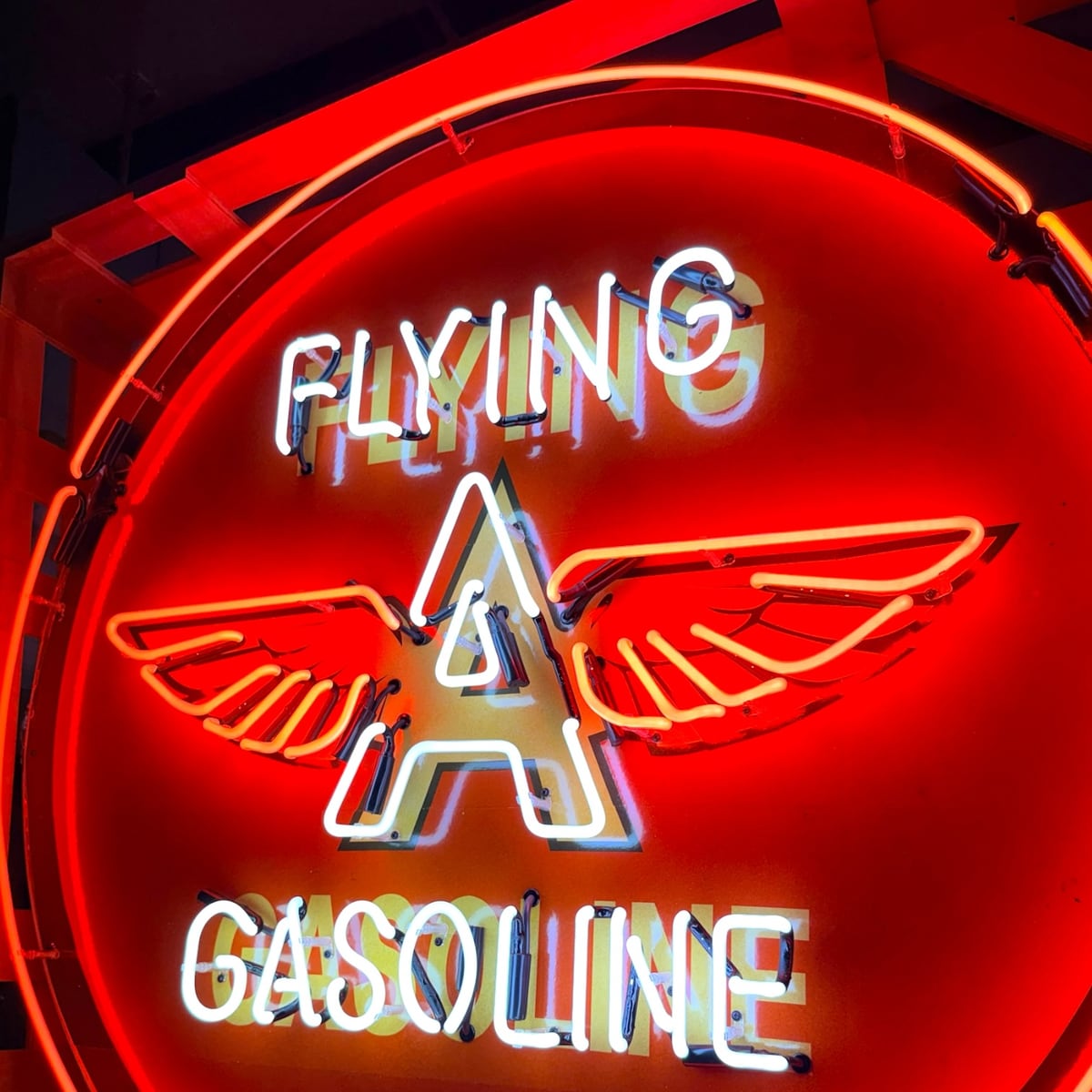
Four-Foot Flying A Gas Neon Porcelain Can
The archived catalog described a newly made, vintage-style porcelain display using real formed-glass neon. The brand subject does not establish affiliation, period manufacture, or provenance.

Lot 1501 · Archived catalog photograph
42-Inch Sinclair Dino Die-Cut Neon Porcelain Can
This object was cataloged as a newly made, vintage-style illuminated display. Its silhouette and depicted brand are design subjects, not evidence of historical age or brand authorization.

Lot 1502 · Archived catalog photograph
48-Inch Mobilgas Pegasus Neon Porcelain Can
The historical listing described real neon and porcelain-enamel construction in a newly made vintage-style display. It was not presented here as a period-original service-station sign.

Lot 1503 · Archived catalog photograph
24-Inch Mobilgas Die-Cut Shield Neon Enamel Display
The display title is condensed from the archived catalog. Construction language does not establish a historic date, original installation, or trademark-owner affiliation.

Lot 137224 · Archived catalog photograph
24-Inch Cadillac Neon Porcelain Can
This was cataloged as a newly made vintage-style display. The depicted crest and service wording are not proof of licensing, dealership provenance, or period manufacture.

Lot 1203 · Archived catalog photograph
24-Inch Die-Cut Shell Gasoline Neon Porcelain Can
The archived lot described newly made, vintage-style neon and porcelain-enamel construction. The familiar graphic does not convert the piece into a period-original advertising sign.

Lot 1205 · Archived catalog photograph
30-Inch Phillips 66 Neon Porcelain Shield
This display was represented as newly made and vintage-style. The permanent guide separates material construction from historical age, provenance, and affiliation.
These are archived actual-item photographs from this completed Bidding Is Open event. The linked HiBid lot records preserve the historical seller wording, additional photographs, and transaction context. A photograph alone does not establish age, originality, material, condition, operation, rarity, affiliation, or current value.
| Lot | Condensed historical catalog title | Reported hammer |
|---|---|---|
| 1500 | Four-Foot Flying A Gas Neon Porcelain Can | $1,800.00 |
| 1501 | 42-Inch Sinclair Dino Die-Cut Neon Porcelain Can | $1,050.00 |
| 1502 | 48-Inch Mobilgas Pegasus Neon Porcelain Can | $1,050.00 |
| 1503 | 24-Inch Mobilgas Die-Cut Shield Neon Enamel Display | $575.00 |
| 137224 | 24-Inch Cadillac Neon Porcelain Can | $475.00 |
| 1203 | 24-Inch Die-Cut Shell Gasoline Neon Porcelain Can | $550.00 |
| 1205 | 30-Inch Phillips 66 Neon Porcelain Shield | $1,500.00 |
These are dated hammer results from one auction. They exclude the 15% buyer's premium, sales tax, shipping, handling, insurance, installation, and any other applicable charges. They are not present asking prices, appraisals, investment guidance, or predictions of what the same or a similar object would bring elsewhere.
Collecting design, fabrication, and documented history
Collectors may respond to typography, color, silhouette, scale, illumination, brand imagery, roadside culture, or fabrication craft. A thoughtful record starts by deciding what kind of object is being collected: a documented period sign, a later reproduction, a newly made decorative display, a restoration containing mixed-age parts, or a contemporary interpretation. Each can have appeal, but the descriptions should not be interchangeable.
- Photograph front, back, edges, mounting points, tubing, supports, wiring, labels, and power equipment.
- Record dimensions and weight. Scale affects display, structure, packing, freight, and installation cost.
- Transcribe every mark. Separate a depicted brand from a fabricator's label, electrical listing, date code, or service notation.
- Describe materials independently. Glass tubing and porcelain enamel can be real even when the piece is newly made.
- Ask for object-specific provenance. A general story about a brand or highway is not the ownership or installation history of one sign.
- Keep repairs visible in the record. Repainted metal, replacement tubes, new transformers, and recreated sections may be appropriate, but they affect interpretation.
Rarity is not established by a familiar logo or dramatic size
Rarity for a documented historic sign might depend on original manufacturer, commission, installation site, date, surviving examples, configuration, size, and condition. For a newly made display piece, a rarity claim would require evidence about the actual production run or fabricator output—not the rarity of an older design it resembles. A low web-search count, seller adjective, unusual color, or brand subject is not enough.
The Library of Congress photograph of a Howard Johnson sign is useful as a documented historical image with a known archival record. It is context for researching roadside sign forms, not a template for dating or authenticating an auction piece.
What can influence value
Potential factors include accurate age and attribution, documented provenance, original versus replacement components, fabrication quality, scale, design appeal, condition, electrical completeness, safe usability, restoration quality, current demand, transportation difficulty, installation cost, and the number of informed bidders in a particular sale. A larger or brighter sign can also cost more to crate, ship, mount, power, insure, and service.
Historical hammer results are most useful when the comparison object, event date, condition evidence, included equipment, venue, and terms are all known. Even then, they describe a past transaction rather than a current appraisal. Brand familiarity does not guarantee value, and a newly made object should not be compared to a documented period original as though age and provenance were equal.
Installation and electrical safety
Formed-glass luminous tubing is fragile, and traditional systems use high voltage. Do not energize an archived-auction purchase merely because an older description said it lit. Before use, have the tubing, electrodes, supports, wiring, enclosure, grounding, power equipment, switches, cord, mounting method, and intended indoor or outdoor location evaluated by an appropriately qualified professional. Applicable electrical, structural, landlord, sign, and fire requirements vary by installation.
Stop using a display that shows damaged glass, arcing, exposed conductors, unusual heat, burning odor, persistent flicker, buzzing that suggests a fault, loose supports, water intrusion, or an unstable mount. Disconnect power before inspection or cleaning, and do not attempt glass-tube or high-voltage repairs without the right training and equipment.
Packing and transport are part of the acquisition
Plan the route before lifting. Photograph the assembly, label removable components, protect glass from direct pressure, immobilize the sign inside a rigid package or crate, and keep weight off the sign face and tubing. Large signs may need separate stabilization for the metal body, glass, transformer or power supply, and hardware. A generic parcel box is not automatically appropriate for a heavy porcelain can with exposed glass.
Confirm dimensions, weight, pickup access, carrier handling, declared-value or cargo-coverage limits, and who is responsible for professional disconnection, crating, delivery, and installation. Preserve loose hardware and fragments with the object's record rather than discarding evidence during unpacking.
Institutional history and preservation sources
- National Park Service Preservation Brief 25: The Preservation of Historic Signs — Historic-sign context, materials, documentation, maintenance, repair, and preservation principles.
- National Park Service: How to Preserve Your Historic Sign — Route 66 sign documentation and preservation guidance.
- National Park Service: Neon Sign Restoration in Missouri — A documented restoration case study for historic neon signage.
- Library of Congress: Emergence of Advertising in America — Primary-source paths into American advertising history.
- Library of Congress: Howard Johnson sign photograph — A documented historical roadside-sign image used for context, not object authentication.